We may earn a commission if you buy through links on this page, at no extra cost to you. How we make money.
Short answer: Eyebright is a small meadow herb used for centuries to soothe red, irritated eyes. Lab studies show its compounds calm inflammation in eye cells, but there are no good human trials showing it improves eyesight or treats eye disease. Drink it as a tea if you like, but never put homemade eyebright preparations in your eyes.
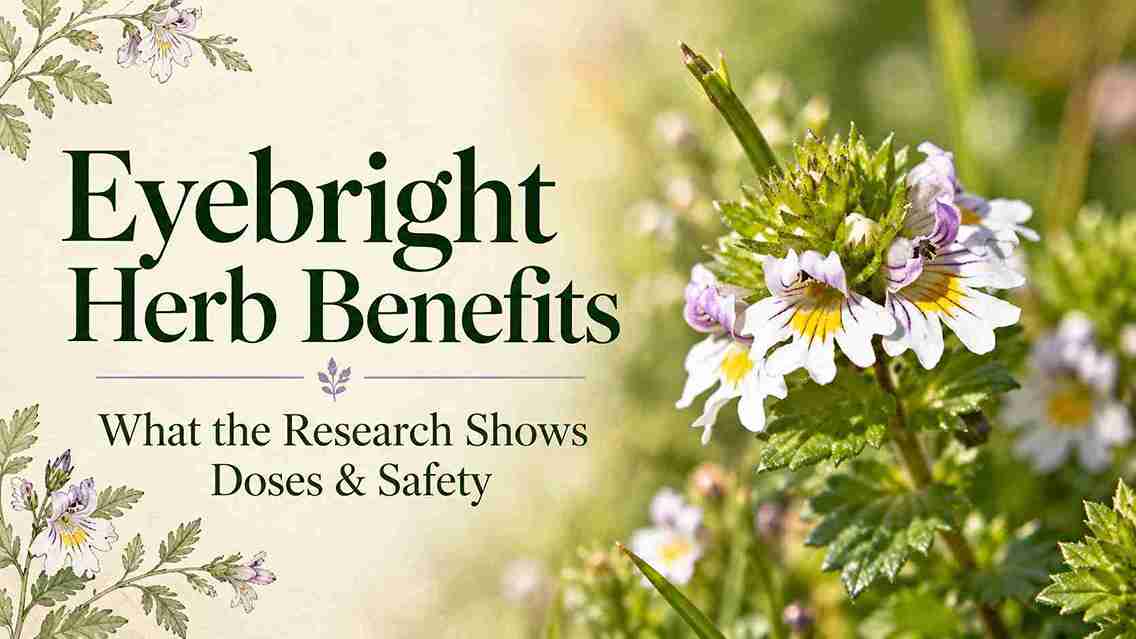
Eyebright (Euphrasia officinalis, also sold as Euphrasia rostkoviana) is a low-growing plant with white and purple flowers that grows in grassland across Europe and western Asia. Its name comes from its traditional use: herbalists have used it for tired, watery and inflamed eyes since at least the Middle Ages. Today you’ll find it in teas, tinctures, capsules, homeopathic eye drops and many “vision support” supplements.
This guide looks at the eyebright herb benefits that research actually supports, how people use it, the doses described in herbal references, the safety risks, and what to look for if you’re considering an eye supplement that contains it. For more herbs, see our herbs and teas guides.
Eyebright at a glance
- Botanical name
- Euphrasia officinalis L. / E. rostkoviana Hayne
- Part used
- Dried flowering plant (above-ground parts)
- Traditional uses
- Red or tired eyes, conjunctivitis, colds and runny nose
- Main compounds
- Iridoid glycosides (such as aucubin), flavonoids, phenolic acids, tannins
- Best human evidence
- Weak: small open studies of homeopathic eye drops
- Official status
- No approved medicinal use in the US or EU
What is eyebright and how does it work?
Eyebright is a semi-parasitic plant: it takes some of its nutrients from the roots of nearby grasses. The flowering tops are dried and used whole, as a tea, or as an alcohol extract called a tincture.
The plant contains several groups of compounds that could, in theory, explain its traditional use. Tannins are astringent, meaning they tighten tissue and may reduce discharge. Iridoid glycosides such as aucubin, and flavonoids such as quercetin and luteolin, have anti-inflammatory and antioxidant effects in lab tests. None of this has been shown to translate into a measurable benefit for people’s eyes.
In Europe, the medicines regulator reviewed eyebright in 2010 and couldn’t approve it even as a traditional herbal medicine. Its reasons were that its effects on the eye weren’t documented, safety data for eye use were missing, and homemade eye washes aren’t hygienic.
What the research shows
Research on eyebright is thin: a few small human studies, mostly of homeopathic eye drops, plus lab and animal work. Each finding below carries an evidence label, explained in our editorial policy.
Soothing irritated, red eyes Limited evidence
The best-known study tested single-dose Euphrasia eye drops, a homeopathic product, in people with conjunctivitis (pink eye not caused by a serious infection). Most patients improved, and few side effects were reported. But there was no comparison group, and conjunctivitis often clears up on its own within days, so the study can’t show the drops caused the improvement.
What the research actually found
- Who
- Adults with red, irritated eyes from conjunctivitis not caused by a serious infection
- What
- Homeopathic Euphrasia single-dose eye drops, used several times a day
- Design
- Open study with no placebo or comparison group (65 patients analyzed in the published results)
- Result
- Most patients had complete or clear improvement in redness, swelling, discharge and burning; the drops were well tolerated
Because nobody received a dummy treatment, this can’t tell us whether the drops worked or the eyes simply healed with time. Europe’s medicines regulator judged the evidence too weak to support any eye use. Read the study.
Preventing conjunctivitis Limited evidence
When eyebright was tested properly, it didn’t help. A double-blind trial in 994 students found that an oral homeopathic Euphrasia product didn’t prevent conjunctivitis any better than a placebo. A randomized trial in 84 babies with blocked tear ducts found Euphrasia drops worked no better than saline.
Calming inflammation in eye cells Limited evidence
In a 2014 lab study, eyebright extracts lowered markers of inflammation in human corneal cells (the clear front layer of the eye) grown in a dish. That’s a useful clue about how the herb might act, but cells in a dish don’t predict what happens in a living eye, and the extracts used weren’t the same as a tea.
Antioxidant activity Limited evidence
Eyebright contains acteoside and other phenolic compounds that neutralize free radicals in lab tests. Many plants, including common foods like spinach and berries, show similar results. There’s no evidence that eyebright’s antioxidants protect your eyes from age-related damage.
Colds, coughs and hay fever Limited evidence
Eyebright is used traditionally for runny noses, sinus congestion and hay fever, usually as a tea or tincture. Its astringent tannins might reduce mucus, but no clinical trials have tested this.
How much eyebright to take
No clinical trial has established a safe or effective dose of eyebright taken by mouth, and there’s no official upper limit. The amounts below are the traditional preparations described by Europe’s medicines regulator and standard herbal references. They show how eyebright is used, not a dose proven to work.
| Form | Amount described in herbal references | Notes |
|---|---|---|
| Tea (infusion), to drink | 2–4 g dried herb per cup of boiling water, up to 3 times a day | Steep 5–10 minutes and strain |
| Tincture (1:5) | 2–6 ml, up to 3 times a day | Contains alcohol |
| Liquid extract (1:1) | 2–4 ml, up to 3 times a day | Concentrated; follow the label |
| Homeopathic eye drops | 1 drop, 3 times a day in studies | Only sterile, single-dose commercial products |
| Capsules and combination supplements | Varies widely | Often undisclosed when part of a blend |
Sources: European Medicines Agency assessment report on Euphrasia (2010); Drugs.com professional monograph on eyebright. These are traditional amounts, not doses tested in controlled trials.
If you want to try eyebright, a cup of tea is the simplest and gentlest option. It tastes mildly bitter and grassy; a little honey or a mint leaf helps.
Tip: buy eyebright tea or dried herb from a brand that names the species (Euphrasia officinalis or E. rostkoviana) and gives a batch number. Loose herbs vary a lot in quality, and that information helps you trace a problem batch.
Side effects and who should avoid it
Eyebright tea seems to be well tolerated in normal amounts, but it has never been properly tested for safety. Higher doses of tincture have been linked with nausea, constipation, sneezing, sweating and trouble sleeping. The biggest risk isn’t the herb itself: it’s putting something non-sterile in your eye.
Who should be careful
- Never use homemade eye washes or compresses: eyebright tea isn’t sterile and can carry bacteria or fungi into the eye, which can cause a serious infection. Use only sterile, commercially made single-dose eye drops if you want to try eyebright on the eye.
- See a doctor rather than self-treating if you have eye pain, blurred or reduced vision, sensitivity to light, thick yellow or green discharge, an eye injury, or symptoms that don’t improve within 2 days. Sudden vision loss is an emergency.
- Contact lens wearers: don’t use any herbal eye product with lenses in, and get red, painful eyes checked promptly.
- Pregnancy and breastfeeding: avoid eyebright, because there’s no safety data.
- Children: don’t give eyebright tea or tincture to children without advice from their doctor.
- Diabetes medicines: eyebright lowered blood sugar in rat studies. If you take diabetes medicine, check with your doctor or pharmacist before taking it regularly.
What actually helps your eyes
If you’re interested in eyebright because you want to protect your eyesight, it helps to know what does have good evidence.
A specific supplement for macular degeneration Strong evidence
Large US government trials (AREDS and AREDS2) found that a specific combination of vitamins and minerals lowers the risk that intermediate age-related macular degeneration (AMD) will progress to the late stage. It doesn’t prevent AMD in people who don’t have it, and it doesn’t help early AMD. The doses matter, so check any product against this formula.
| Nutrient | Daily amount |
|---|---|
| Vitamin C | 500 mg |
| Vitamin E | 400 IU |
| Zinc | 80 mg |
| Copper | 2 mg |
| Lutein | 10 mg |
| Zeaxanthin | 2 mg |
Source: National Eye Institute. AREDS2 contains no beta-carotene, which raised lung cancer risk in smokers and former smokers in the original AREDS trial.
Everyday habits Strong evidence
Regular eye exams catch problems like glaucoma and AMD early, when treatment works best. Not smoking, wearing sunglasses that block UV light, and eating plenty of leafy greens (rich in lutein and zeaxanthin) also support long-term eye health. You can check the lutein-rich vegetables you eat in our food nutrition lookup.
How to choose an eye supplement with eyebright
Eyebright is rarely sold alone in capsules. It usually appears as one ingredient among many in “vision support” formulas. Before you buy one, check these points:
- Full doses on the label: a “proprietary blend” that hides individual amounts makes it impossible to compare with research doses such as AREDS2.
- Third-party testing: look for a USP Verified, NSF or similar seal, which confirms the product contains what the label says.
- Ingredients that interact with medicines: ginkgo can raise bleeding risk with blood thinners, aspirin or ibuprofen, and should be stopped two weeks before surgery. Coleus forskohlii (forskolin) can lower blood pressure and may add to blood pressure medicines.
- Beta-carotene: if you smoke or used to, avoid high-dose beta-carotene for eye health.
- Big promises: no supplement can “restore” vision or replace treatment from an eye doctor. Claims like that are a red flag.
One example is VisiFlora, a once-daily capsule marketed around a “gut-eye” idea. According to the brand’s sales page, it lists eyebright among about 21 ingredients, including lutein, zeaxanthin, bilberry, saffron, astaxanthin, ginkgo, coleus forskohlii and vitamin A as beta-carotene. Only the zinc dose (11 mg) is shown, so you can’t compare the rest with AREDS2, and the gut-eye framing is the brand’s own idea rather than an established treatment. It’s sold online at $49 to $79 a bottle depending on how many you buy, with a 60-day money-back guarantee. If you’re weighing it up, you can check VisiFlora’s current price and ingredient list on the official site, and read this detailed VisiFlora review for more on the formula. Because it contains ginkgo and coleus, check with your doctor or pharmacist first if you take blood thinners or blood pressure medicine.
Read more about how we judge products in how we review supplements.
Eyebright FAQ
Can eyebright improve eyesight?
No. There’s no evidence that eyebright improves vision, reverses short- or long-sightedness, or treats cataracts, glaucoma or macular degeneration. Any change in your vision should be checked by an eye doctor.
Is it safe to put eyebright tea in your eyes?
No. Homemade tea isn’t sterile and can cause eye infections. Europe’s medicines regulator specifically warned that homemade eye preparations don’t meet hygiene standards. If you want to try eyebright on the eye, use only sterile single-dose drops made for eye use.
How do you make eyebright tea?
Pour a cup of freshly boiled water over 2 to 4 g (about 1 to 2 teaspoons) of dried eyebright, cover, steep for 5 to 10 minutes and strain. Drink it; don’t use it as an eye wash.
Does eyebright help with allergies or hay fever?
It’s used traditionally for itchy, watery eyes and runny noses, but it hasn’t been tested in clinical trials for allergies. Standard antihistamine eye drops and tablets have much better evidence.
Is eyebright the same as bilberry?
No. Bilberry (Vaccinium myrtillus) is a blueberry relative also marketed for eyes. They’re unrelated plants, and both are often combined in eye supplements.
Sources
- European Medicines Agency, Committee on Herbal Medicinal Products. Assessment report on Euphrasia officinalis L. and Euphrasia rostkoviana Hayne, herba (EMA/HMPC/246799/2009), 2010.
- Stoss M, et al. (2000). Prospective cohort trial of Euphrasia single-dose eye drops in conjunctivitis. Journal of Alternative and Complementary Medicine, 6, 499.
- Drugs.com. Eyebright: professional monograph (summarizing Mokkapatti 1992, Paduch 2014, Gerstenberg 2019 and other studies).
- National Eye Institute. Nutritional supplements for age-related macular degeneration (AREDS and AREDS2).
- Mayo Clinic. Ginkgo: safety, side effects and interactions.
- Memorial Sloan Kettering Cancer Center. Forskolin (Coleus forskohlii): side effects and interactions.
- VisiFlora official sales page (tryvisiflora.com), product details checked October 20, 2026.