
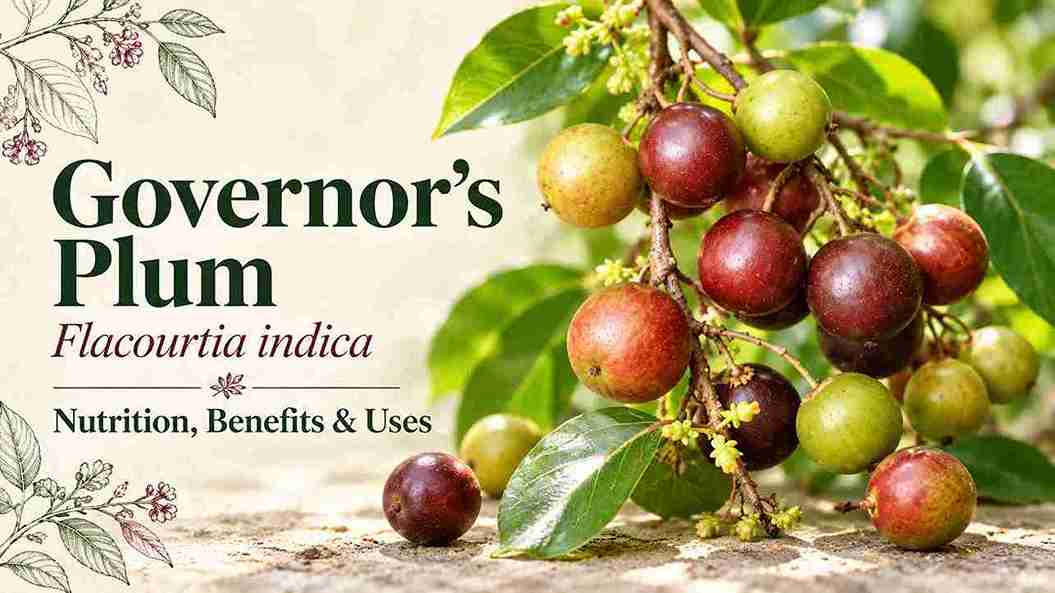
Short answer: Flacourtia indica, usually called governor’s plum, is a small dark red to purple berry from a thorny tropical shrub. The ripe fruit is edible, sweet-tart and good in jams. Very little is known about its nutrition, and its health claims come almost entirely from rat and lab studies of extracts, not from people eating the fruit.
Governor’s plum grows wild across tropical Africa, Madagascar and southern and Southeast Asia. Over the past century it has spread to gardens and hedgerows in Florida, Hawaii and other warm places. It goes by many names, including Indian plum, Madagascar plum, batoka plum and ramontchi, which can make the research hard to follow.
This guide explains what’s actually known about Flacourtia indica. It covers what the fruit is like, what scientists have measured in it and what the health research does and doesn’t show. It also explains how to eat, buy and grow it safely. For more tropical fruits, see our fruits guides.
Governor’s plum at a glance
- Botanical name
- Flacourtia indica (Burm. f.) Merr., family Salicaceae
- Other names
- Indian plum, Madagascar plum, batoka plum, ramontchi
- Fruit
- Round berry up to 0.8 in (2 cm), red to dark purple when ripe
- Taste
- Juicy, sweet-tart; astringent when underripe
- Native to
- Tropical Africa, Madagascar and tropical Asia
- USDA nutrition data
- None available
What governor’s plum looks and tastes like
Governor’s plum is a small round berry, usually about 0.4 to 0.8 in (1 to 2 cm) across. It turns from green to red and then to a deep purple or nearly black when fully ripe. Inside is juicy, yellowish to reddish flesh with 6 to 10 small, flat seeds.
Ripe fruit tastes sweet with a sharp, slightly sour edge. Underripe fruit is noticeably astringent: it leaves a dry, puckering feeling in your mouth.
The plant itself is an evergreen shrub or small tree that can reach about 33 ft (10 m). It has sharp spines on the trunk and branches, and leathery, toothed leaves. Male and female flowers grow on separate plants, so only female trees bear fruit.
Flacourtia indica nutrition: what’s actually known
There’s no entry for governor’s plum in USDA FoodData Central or other major food composition tables, so reliable nutrition facts don’t exist yet. A handful of small lab studies have analyzed the fruit, but they used different methods and don’t always say whether their figures are for fresh or dried fruit.
The most detailed recent analysis, from fruit collected in West Bengal, India, reported these values per 100 g:
| Component | Reported per 100 g |
|---|---|
| Moisture | 41.6 g |
| Carbohydrate | 21.8 g |
| Fiber | 2.6 g |
| Fat | 1.9 g |
| Protein | 1.5 g |
Source: Mal et al. (2025), Prospects in Pharmaceutical Sciences. The study doesn’t say whether these values are for fresh or partly dried fruit; a moisture of about 42% is far lower than most fresh berries (usually 80–90%), so treat the figures as rough. We haven’t calculated % Daily Values for this reason.
What the studies agree on is that the fruit, and especially its dark skin, is rich in plant compounds called polyphenols, including anthocyanins, the pigments that give it its purple color. One Sri Lankan study found the peel had far more of these compounds than the seeds. Vitamin C and mineral content haven’t been reliably measured, so be wary of any website that gives exact figures for them.
Flacourtia indica health benefits
No study has tested governor’s plum in people. Everything below comes from animal or lab research, usually using concentrated extracts. Each benefit carries an evidence label, explained in our editorial policy.
Antioxidant compounds in the fruit Limited evidence
Extracts of the fruit and peel neutralize free radicals in test tubes, which is what “antioxidant activity” usually means in these studies. That’s a property of the compounds in a lab, not proof that eating the fruit protects you from disease. Many dark-colored fruits, such as blueberries and blackberries, show similar results.
Heart protection in rats Limited evidence
The most detailed study of the fruit itself looked at heart damage in rats. Rats given a fruit extract had less heart injury from a heart-stressing drug, and their markers of inflammation and oxidative stress were lower.
What the research actually found
- Who
- Long-Evans rats given isoprenaline, a drug that damages heart tissue
- What
- An extract of Flacourtia indica fruit, compared with the heart drug atenolol
- Result
- Heart weight, heart-damage enzymes (such as CK-MB) and inflammation markers moved back toward normal, with effects the authors described as comparable to atenolol
This is a single animal study of a concentrated extract. It doesn’t show that eating governor’s plum helps the human heart, and the fruit is no substitute for heart medicines. Read the study.
Blood sugar enzymes in lab tests Limited evidence
In test-tube studies, fruit extracts slowed two digestive enzymes, alpha-amylase and alpha-glucosidase, that break down starch into sugar. Some diabetes medicines work on the same enzymes. Leaf extracts have also lowered blood sugar in diabetic rats. None of this has been tested in people, so the fruit shouldn’t be used to manage diabetes.
Liver effects of leaf extracts in rats Limited evidence
Several rat studies found that extracts of the leaves or other above-ground parts reduced liver damage caused by drugs such as paracetamol (acetaminophen). These studies used parts of the plant people don’t normally eat, at concentrated doses.
Traditional uses of Flacourtia indica
Across Africa and Asia, almost every part of the plant has a place in folk medicine. These uses are recorded by ethnobotanists, but they haven’t been tested in clinical trials.
- Fruit: eaten for nausea, vomiting and “bilious” stomach complaints; ripe fruit used as a liver tonic in Sri Lanka, and for jaundice in Tanzania.
- Leaves: dried leaves for coughs, asthma and bronchitis; fresh leaf juice for fevers.
- Bark: an infusion gargled for hoarseness, and rubbed on in oil for joint pain.
- Roots: used for kidney complaints, intestinal worms and coughs.
Traditional use tells researchers where to look. It doesn’t tell you what dose is safe or whether a remedy works, so we don’t recommend using the leaves, bark or roots at home.
Who should be careful
The ripe fruit has been eaten for generations and is generally considered safe as food. The main risks come from medicinal use of other plant parts, and from foraging.
Who should be careful
- Pregnancy and breastfeeding: eat the ripe fruit only as an occasional food. Avoid leaf, bark and root remedies, which have never been tested for safety in pregnancy.
- Babies and young children: some traditions give plant preparations to infants. Don’t: there’s no safety data, and the small seeds can be a choking risk for toddlers.
- Diabetes or heart medicines: because lab and animal studies suggest effects on blood sugar and the heart, ask your doctor or pharmacist before taking any Flacourtia indica extract or supplement.
- Foragers: only eat berries you can identify with certainty. Watch for the sharp spines when picking, and wear gloves.
- Allergies: stop eating it if your mouth tingles or swells. Get emergency help for swelling of the throat or trouble breathing.
How to eat and use governor’s plum
Pick or buy fruit that’s deep purple or nearly black and slightly soft. Red or firm fruit is underripe and will taste astringent. Rinse the berries, then eat them whole, spitting out the small seeds, or squeeze the flesh away from them.
- Fresh: as a snack, or scattered over yogurt, oatmeal or fruit salad.
- Jams and jellies: the most popular use. The tart flavor works well with sugar; strain out the seeds after cooking.
- Stewed or in sauces: cook the berries with a little sugar for a sauce to serve with pancakes, or with savory dishes as you would cranberry sauce.
- Dried or fermented: the fruit is dried for storage in some regions and made into a homemade wine.
Tip: got a batch that’s still a bit astringent? Cook it. Simmering the berries with sugar for jam or sauce softens that dry, puckering taste far better than eating them raw.
You’re unlikely to find governor’s plum in US supermarkets. Look for it in backyards and farmers’ markets in South Florida and Hawaii in season, or at markets serving South Asian and African communities. Ripe berries are soft and don’t keep well: refrigerate them and use within two or three days, or freeze them for jam.
Growing governor’s plum
Governor’s plum grows easily in frost-free climates (USDA hardiness zones 10 to 12) and tolerates drought and poor, sandy soil. Its spines make it a popular hedge plant. Plants are either male or female and only females bear fruit, so you’ll usually need both. Ask the nursery which you’re buying.
In Florida, check before you plant. The University of Florida’s invasive plant assessment rates it “Caution: manage to prevent escape” in Central and South Florida, because birds spread the seeds into natural areas. The Florida Invasive Species Council lists it as a Category II invasive. If you grow it there, pick fruit promptly and remove seedlings that pop up.
Governor’s plum vs similar fruits
Several small tropical “plums” get mixed up in shops and online articles. Here’s how governor’s plum compares with three that US readers are more likely to meet.
| Fruit | Botanical name | Looks like | Taste | USDA nutrition data |
|---|---|---|---|---|
| Governor’s plum | Flacourtia indica | Small round berry, red to purple-black, several tiny seeds | Sweet-tart, astringent if underripe | No |
| Indian coffee plum | Flacourtia jangomas | Close relative; slightly larger, dark red to purple | Sweet-sour | No |
| Java plum (jamun) | Syzygium cumini | Oval, glossy purple-black, one large seed | Sweet, astringent, stains the tongue purple | Yes |
| Natal plum | Carissa macrocarpa | Bright red, oval, thorny shrub with white flowers | Sweet, cranberry-like | Yes |
Because Java plum and Natal plum have USDA entries, you can see their full nutrition labels in our food nutrition lookup. Don’t use their numbers for governor’s plum: they’re different plants.
Flacourtia indica FAQ
Is Flacourtia indica fruit edible?
Yes. The ripe, dark purple fruit is eaten fresh and made into jams, jellies and sauces in many tropical countries. Avoid eating large amounts of underripe fruit, which is astringent and can upset your stomach.
Is governor’s plum the same as Indian plum?
Often, yes: “Indian plum” is one of the common names for Flacourtia indica. But the same name is also used for other plants, including jujube (Ziziphus mauritiana) and a North American shrub (Oemleria cerasiformis), so check the botanical name.
Can you eat the seeds of governor’s plum?
The seeds are small and are usually spat out or strained out of jams. There’s no research on eating them in quantity, so there’s no reason to eat them on purpose.
Does Flacourtia indica help with diabetes?
There’s no evidence it helps people with diabetes. Lab and rat studies of extracts found effects on blood sugar, but these haven’t been tested in humans. Keep taking any diabetes treatment your doctor prescribed.
When is governor’s plum in season?
It depends on the region. Fruit ripens over several weeks after the trees flower, often in the warm, wet months. Ask local growers or gardeners when trees in your area fruit.
Sources
- Mal B, et al. (2025). Food value analysis, phytochemical profiling, LC/MS analysis, antioxidant and antimicrobial activity of methanolic extract of Flacourtia indica fruits of lateritic West Bengal. Prospects in Pharmaceutical Sciences, 23(2), 84–95.
- Jayasinghe JMHM, Weerasooriya MKB. (2021). Antioxidant potential and nutritional composition of peel and seeds of Flacourtia indica fruit. Proceedings of RESCON 2021, University of Peradeniya.
- Akter N, et al. (2020). Polyphenolics in ramontchi protect cardiac tissues via suppressing isoprenaline-induced oxidative stress and inflammatory responses in Long-Evans rats. Journal of Functional Foods, 75, 104250.
- Gunasekara H, Panchal SK. (2026). Nutritional and therapeutic potential of underutilised fruits from Sri Lanka. Applied Sciences, 16(8), 3975.
- Hossain MM, et al. (2021). Biochemical properties of some important underutilized minor fruits. Journal of Agriculture and Food Research, 5, 100148.
- University of Florida IFAS. Assessment of non-native plants in Florida’s natural areas: Flacourtia indica.
- Florida Natural Areas Inventory. Governor’s plum (Flacourtia indica).
- Stuart G. Philippine Medicinal Plants: Palutan (Flacourtia indica), summary of traditional uses and published studies.