
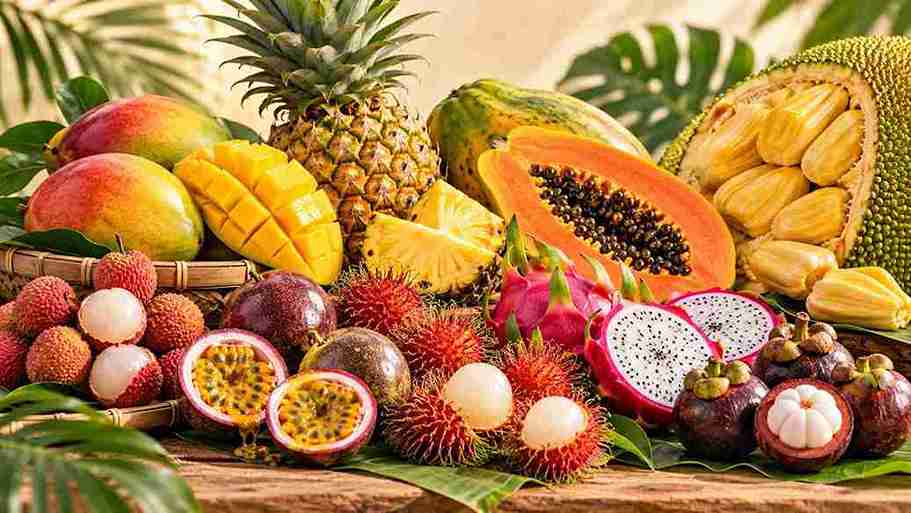
Short answer: This tropical fruits list covers 30 different fruits, from mango and rambutan to breadfruit and acerola. Some are sweet snacks; others are tart ingredients or starchy foods best cooked before eating.
Use this guide to compare flavours, textures and serving ideas. Taste varies with the variety and ripeness. For more fruit guides, see our fruits section.
Tropical fruits list: 30 fruits to explore
1. Mango
Mangoes are often called the “king of fruits.” They possess a juicy, sweet flavor with hints of citrus. When ripe, their flesh is soft, making them perfect for desserts or smoothies.
2. Pineapple
This tropical favorite is sweet and tart, with a juicy texture. Pineapples are great on their own, in fruit salads, or grilled as a snack.
3. Papaya
Papaya has a soft, buttery flesh that tastes sweet with notes of cantaloupe. It’s often enjoyed raw or blended into smoothies.
4. Passion Fruit
This round, purple fruit has a strong, tangy flavor with a hint of sweetness. The seeds add an enjoyable crunch, making it a great addition to yogurts or desserts. Read our full passion fruit guide.
5. Lychee
Lychees have a floral, sweet taste, often compared to a combination of grape and rose. Their juicy flesh is refreshing and perfect for snacking.
6. Guava
Guavas are sweet with a hint of tartness. Their flavor profile varies from fragrant strawberry to mild pear, making them versatile in both sweet and savory dishes.
7. Dragon Fruit
With its vibrant pink exterior and speckled white or red flesh, dragon fruit has a mild sweetness and a texture similar to kiwi. It’s perfect for smoothies and fruit bowls.
8. Coconut
Coconuts are unique in that both the water and the meat offer different tastes. The water is refreshing while the meat is creamy and mildly sweet. It’s a staple in many tropical dishes.
9. Jackfruit
Ripe jackfruit has sweet, fragrant yellow bulbs. Young, unripe jackfruit has a much milder flavour and a fibrous texture that works in cooked savory dishes.
10. Rambutan
Rambutans are sweet with a slightly acidic touch, somewhat akin to lychees. Their juicy flesh is encased in a hairy outer skin, making them visually interesting as well. Read our full rambutan guide.
11. Starfruit
This fruit is crisp and juicy, with a sweet-tart flavor. Its distinct star shape makes it a favorite for garnishing dishes, adding both flavor and visual appeal. Read our full starfruit guide.
12. Durian
Known as the “king of fruits,” durian has a strong smell and a rich, custard-like texture. Its taste is complex, often described as sweet and savory with hints of almonds.
13. Sapodilla
With a taste reminiscent of brown sugar, sapodilla is sweet and grainy. It is often eaten raw or used in smoothies and desserts.
14. Soursop
Soursop has a sweet, tangy flavor that combines hints of pineapple and strawberry. It’s perfect for juices and is often used in desserts.
15. Mangosteen
Mangosteen is known for its sweet, slightly tangy flavor, often described as a mix between peach and strawberry. The creamy, white flesh offers a refreshing treat.
16. Longan
This small, round fruit has a sweet and floral taste, similar to lychee. It’s often enjoyed fresh or dried. Read our full longan guide.
17. Tamarind
Tamarind offers a sweet and tangy flavor with a sticky texture. It’s commonly used in sauces, drinks, and snacks.
18. Bilimbi
Bilimbi has a tart flavor that adds brightness to dishes. They are often used in curries or pickles due to their sour taste.
19. Chayote
Chayote is botanically a fruit but is usually prepared as a vegetable. It has a mild flavor, similar to cucumber, and can be eaten raw or cooked.
20. Banana
Ripe bananas are sweet, soft and creamy. Eat them fresh, slice them over oatmeal, or freeze peeled pieces for smoothies. Plantains are related but are usually cooked.
21. Calamondin
Calamondin is a small, sour citrus fruit that adds a zesty punch to dishes and drinks, making it a popular ingredient in marinades and dressings.
22. Noni Fruit
Noni fruit has a strong, pungent smell, but its flavor can be earthy and slightly bitter. It is sometimes processed into juice, but it is not a typical sweet snacking fruit.
23. Pepino Melon
Pepino melon has a sweet, honey-like flavor with hints of cucumber. Its smooth skin and juicy flesh make it a refreshing snack.
24. Kiwano
Kiwano, or horned melon, has a taste similar to a mix of banana and cucumber. Its spiky exterior makes it visually engaging as well.
25. Acai Berry
Acai berries have a subtle sweetness with a hint of tartness. They’re often used in smoothie bowls and health foods.
26. Golden Berries
Golden berries are sweet and tart, packed into a tiny, bright orange shape. They’re a great addition to desserts and salads.
27. Cacao Fruit
Cacao fruit contains sweet, white pulp surrounding cacao seeds. The pulp can be eaten fresh, while the seeds are used to make chocolate.
28. Salak (Snake Fruit)
Salak, known as snake fruit due to its scaly skin, has a sweet and tangy flavor, often described as reminiscent of apples and bananas.
29. Breadfruit
Breadfruit is usually cooked and served as a starchy food. Its mild flesh works well roasted, boiled or baked, making it quite different from the juicy dessert fruits on this list.
30. Acerola
Acerola is a small red fruit with a tart taste. It is used in juices, preserves and frozen pulp. Look for it in Latin American grocery stores, as fresh fruit can be difficult to find.
Tropical fruit nutrition compared
Tropical fruits vary more than you might expect. Some are almost as low in calories as melon, while others, such as durian and breadfruit, are closer to a starchy vegetable. Here’s how 13 common tropical fruits compare per 100 grams (about 3.5 oz) of raw fruit, using USDA values:
| Fruit (100 g) | Calories | Fiber | Vitamin C | Potassium |
|---|---|---|---|---|
| Guava | 68 | 5.4 g | 228 mg | 417 mg |
| Passion fruit | 97 | 10.4 g | 30 mg | 348 mg |
| Longan | 60 | 1.1 g | 84 mg | 266 mg |
| Lychee | 66 | 1.3 g | 72 mg | 171 mg |
| Papaya | 43 | 1.7 g | 61 mg | 182 mg |
| Pineapple | 50 | 1.4 g | 48 mg | 109 mg |
| Mango | 60 | 1.6 g | 36 mg | 168 mg |
| Star fruit | 31 | 2.8 g | 34 mg | 133 mg |
| Breadfruit | 103 | 4.9 g | 29 mg | 490 mg |
| Soursop | 66 | 3.3 g | 21 mg | 278 mg |
| Durian | 147 | 3.8 g | 20 mg | 436 mg |
| Jackfruit | 95 | 1.5 g | 14 mg | 448 mg |
| Banana | 89 | 2.6 g | 9 mg | 358 mg |
Values from USDA FoodData Central for raw fruit. The Daily Value for vitamin C is 90 mg, for fiber 28 g and for potassium 4,700 mg.
A few patterns stand out. Guava is the vitamin C champion: 100 grams provides about two and a half times the daily value, far more than an orange. Passion fruit is one of the highest-fiber fruits you can buy, thanks to its edible seeds. Star fruit and papaya are the lowest in calories, while durian, breadfruit and jackfruit are much more filling and are also among the best fruit sources of potassium.
For more detail, see our guides to high-fiber fruits, fruits high in vitamin C and low-sugar fruits, or look up any fruit in our food nutrition lookup.
Safety notes for some tropical fruits
Most tropical fruits are safe and healthy for nearly everyone, but a few come with warnings worth knowing:
- Star fruit: people with kidney disease should never eat star fruit or drink its juice. It contains a nerve toxin and a lot of oxalate that damaged kidneys can’t clear. See our star fruit guide.
- Soursop: enjoy the fruit occasionally, but never eat the seeds, and avoid daily leaf tea and supplements because of a compound linked to nerve damage. See our soursop guide.
- Ackee: unripe ackee, and the seeds and pink membrane of any ackee, contain a toxin that can cause severe low blood sugar. Only eat properly prepared, fully ripe fruit. See our ackee guide.
- Mango skin: mango peel and sap contain urushiol, the same irritant found in poison ivy. People who react to poison ivy may get an itchy rash around the mouth from mango skin; peeling the fruit usually prevents this.
- Latex allergy: people allergic to latex are more likely to react to banana, avocado, kiwi, papaya and passion fruit, a pattern called latex-fruit syndrome. Talk to an allergist if you’ve reacted to any of these.
- Noni juice: noni is high in potassium, so people with kidney disease or taking potassium-raising medicines should avoid it, and rare cases of liver injury have been reported with noni products.
- Seeds and pits: the seeds of lychee, longan, rambutan and many other tropical fruits shouldn’t be eaten. Remove them before giving fruit to children, as they’re also a choking risk.
Unripe lychees eaten on an empty stomach have also been linked to dangerously low blood sugar in undernourished children in parts of Asia. For healthy people eating ripe fruit as part of a normal diet, lychees are safe. See our lychee guide for details.
Buying and serving tips
Start with one unfamiliar fruit rather than buying a large quantity. Ask the seller how to recognise ripeness and which parts are edible. Specialty grocery stores may carry frozen pulp when fresh fruit is unavailable.
Wash fruit before cutting it. Remove skins, stones and seeds as appropriate for the fruit; do not assume that every part is edible. Follow storage instructions on packaged fruit and refrigerate cut fruit promptly.
For a closer look at two tropical fruits, read our rambutan guide and governor’s plum guide.
More guides you may find useful: ackee, canistel, bignay, jamun, cherimoya, goraka (garcinia) and exotic fruits to try.
Frequently asked questions
Are pitaya and dragon fruit different fruits?
Pitaya is another name commonly used for dragon fruit. They should not be counted as two separate fruits in a list.
Are kiwano and African horned cucumber the same?
Yes. Kiwano is also known as horned melon or African horned cucumber.
Are all tropical fruits sweet?
No. Bilimbi and calamondin are sour, while breadfruit and chayote are often used in savory cooking.