Short answer: Rambutan is a sweet, juicy tropical fruit related to lychee. Fresh rambutan gives you a useful amount of vitamin C, and even the canned kind supplies manganese and copper. Most of the dramatic health benefits you’ll read about come from lab tests on the peel and seeds, which people don’t normally eat, not from studies of people eating the fruit.
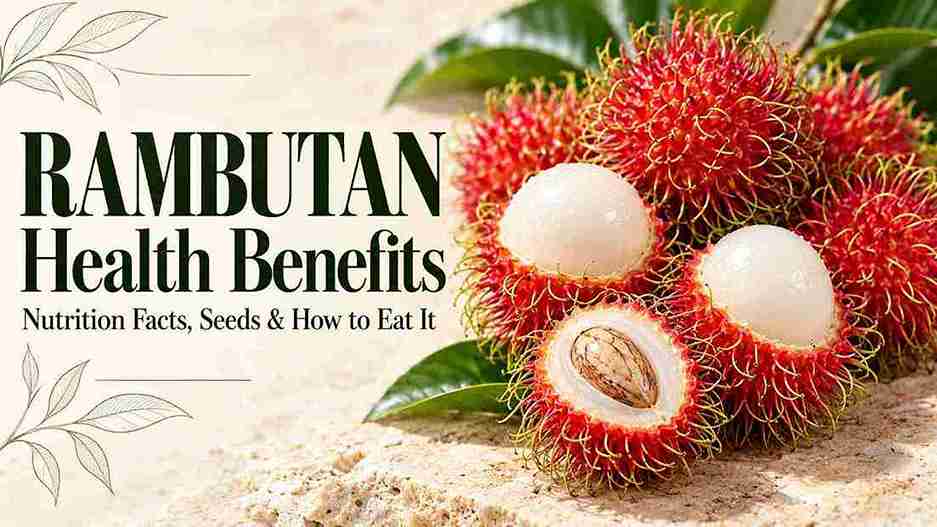
Rambutan (Nephelium lappaceum) grows on evergreen trees across Southeast Asia, from Malaysia and Indonesia to Thailand and the Philippines. Its name comes from the Malay word rambut, meaning hair, because the red or yellow shell is covered in soft, bendy spines. Inside is a translucent white fruit that tastes like a grape crossed with a lychee, wrapped around a single inedible seed.
This guide covers rambutan nutrition facts from USDA data and the rambutan health benefits that actually hold up. It also explains what the peel and seed research does and doesn’t show, and how to buy, open and store the fruit. For more tropical and everyday fruits, see our fruits guides.
Rambutan at a glance
- Calories
- 82 per 3.5 oz (100 g), canned and drained; about 75 fresh
- Best source of
- Vitamin C (fresh fruit), manganese, copper
- Taste
- Sweet and mildly tart, like a grape crossed with lychee
- Availability
- Fresh at Asian grocers in summer and fall; canned year-round
- Native to
- Malaysia and Indonesia
Rambutan nutrition facts
USDA FoodData Central lists rambutan only in its canned form, so the table below is for rambutan canned in syrup and drained. It’s the version most US shoppers can buy all year. Fresh fruit differs in a few important ways, covered in the next section.
| Nutrient | Per 3.5 oz (100 g) | Per 1 cup, drained (150 g) | % DV per 1 cup, drained |
|---|---|---|---|
| Calories | 82 | 123 | – |
| Protein | 0.65 g | 0.97 g | 2% |
| Total fat | 0.21 g | 0.32 g | <1% |
| Cholesterol | 0 mg | 0 mg | 0% |
| Carbohydrates | 21 g | 31 g | 11% |
| Fiber | 0.9 g | 1.4 g | 5% |
| Sodium | 11 mg | 16 mg | <1% |
| Potassium | 42 mg | 63 mg | 1% |
| Calcium | 22 mg | 33 mg | 3% |
| Iron | 0.35 mg | 0.53 mg | 3% |
| Magnesium | 7 mg | 10 mg | 2% |
| Phosphorus | 9 mg | 14 mg | 1% |
| Zinc | 0.08 mg | 0.12 mg | 1% |
| Copper | 0.07 mg | 0.1 mg | 11% |
| Manganese | 0.34 mg | 0.51 mg | 22% |
| Vitamin C | 4.9 mg | 7.3 mg | 8% |
| Thiamin (B1) | 0.01 mg | 0.02 mg | 2% |
| Riboflavin (B2) | 0.02 mg | 0.03 mg | 3% |
| Niacin (B3) | 1.4 mg | 2 mg | 13% |
| Vitamin B6 | 0.02 mg | 0.03 mg | 2% |
| Folate (DFE) | 8 mcg | 12 mcg | 3% |
Source: USDA FoodData Central — Rambutan, canned, syrup pack (SR Legacy, FDC ID 168167). % Daily Value (DV) uses FDA values for a 2,000-calorie diet. USDA gives no sugar figure for this entry; nearly all the carbohydrate is sugar from the fruit and the syrup.
The headline numbers: a cup of drained canned rambutan has about 123 calories, almost no fat or protein, and 31 g of carbohydrate. Its standout nutrient is manganese, at 22% of the Daily Value. It also gives 13% of your niacin and 11% of your copper. It’s a light dessert fruit rather than a major source of anything.
Fresh vs canned rambutan: what changes
Canning cuts the vitamin C sharply and adds sugar. Canned rambutan has 4.9 mg of vitamin C per 100 g. A 2023 review of fresh-fruit analyses reports roughly 21 to 50 mg per 100 g, depending on the variety, with some Mexican cultivars reaching close to 70 mg. That means 100 g of fresh rambutan can give you a quarter to half of your daily vitamin C.
The syrup also raises the calories. The Norwegian food composition table lists fresh rambutan at about 75 calories per 100 g, compared with 82 for canned and drained. If you drink the syrup too, you add a lot more sugar.
For the best nutrition, choose fresh or frozen rambutan when you can find it. If you buy canned, look for fruit packed in juice or light syrup, and drain it.
Rambutan health benefits
There are very few studies of people eating rambutan. Each benefit below carries an evidence label, explained in our editorial policy. The strongest ones come from the nutrients the fruit contains, which are measured and well understood.
Helps you meet your vitamin C needs (fresh fruit) Strong evidence
Your body needs vitamin C to make collagen for skin and blood vessels, to absorb iron from plant foods and to keep your immune system working normally. Adults need 75 to 90 mg a day. A generous handful of fresh rambutan (about 100 g, or 8 to 10 fruits) can cover a quarter to half of that. Canned rambutan won’t do much here.
Supplies manganese and copper Strong evidence
A cup of canned rambutan gives 22% of the Daily Value for manganese and 11% for copper. Manganese helps your body process carbohydrates and build bones, and copper is needed to make red blood cells and to use iron. Most people get enough of both from a varied diet, so rambutan is a small helper rather than a fix.
A low-fat, low-calorie sweet option Strong evidence
Fresh rambutan is about 80% water, with around 75 calories per 100 g and almost no fat. If you want something sweet, a bowl of fresh fruit is a lighter choice than most desserts. It isn’t high in fiber, though: about 1 g per 100 g, so it won’t keep you full for long on its own. Our fiber calculator shows how much you need each day.
Antioxidants in the fruit Limited evidence
Rambutan flesh contains vitamin C and small amounts of plant compounds called phenolics, which act as antioxidants in lab tests. That doesn’t show that eating rambutan protects against disease. The impressive antioxidant numbers in articles about rambutan almost always come from the peel, not the part you eat.
What about rambutan peel and seeds?
Most research on rambutan looks at the peel (rind) and the seeds, which are usually thrown away. Here’s what that research found, and why it doesn’t translate into advice to eat them.
Peel: blood sugar effects in rats Limited evidence
Rambutan peel is rich in a compound called geraniin, along with ellagic acid and corilagin. In lab tests, these compounds were stronger antioxidants than the synthetic food preservative BHT. In one rat study, a concentrated alcohol extract of the peel lowered blood sugar in diabetic rats about as well as the drug metformin.
What the research actually found
- Who
- Male rats with diabetes induced by a high-fat diet and drugs
- What
- An alcohol extract of rambutan peel at two doses, compared with metformin
- How long
- 28 days
- Result
- The higher dose lowered blood glucose and improved insulin levels, with results similar to metformin, and the pancreas looked healthier
This was an animal study using a concentrated extract, not the fruit or the peel as food. No human trial has tested rambutan peel for blood sugar, so it shouldn’t be used to manage diabetes. Read the study.
Seeds: edible only when roasted Limited evidence
Rambutan seeds contain a lot of fat and have been studied as a possible source of cooking fat. Raw seeds taste bitter and contain saponins and tannins. In large amounts, saponins can cause nausea, vomiting and diarrhea. Traditional sources describe raw seeds as narcotic and possibly poisonous. In parts of the Philippines, people roast the seeds and eat them, and roasting is thought to break down much of the bitter, irritating content.
No safe amount has been established, and there’s no research showing health benefits from eating the seeds. The simple rule: eat the flesh and throw the seed away.
Who should be careful
Rambutan flesh is safe for most people. A few groups should take care.
Who should be careful
- Young children: the seed is a choking hazard. Remove it, and cut the flesh into small pieces for toddlers.
- Diabetes: rambutan is sugary, and canned rambutan in heavy syrup even more so. Count it as part of your carbohydrate for the meal and choose fresh, or canned in juice.
- Allergies: allergy to rambutan is uncommon, but people allergic to lychee or longan, close relatives, may react to it. Get emergency help if you have swelling of the lips or throat, or trouble breathing.
- Raw seeds and peel: don’t eat them. Peel extracts sold as supplements haven’t been tested for safety in people. If you take diabetes medicine, ask your doctor or pharmacist before trying one, because the animal research points to an effect on blood sugar.
How to choose, store and eat rambutan
In the US, look for fresh rambutan at Asian supermarkets and some larger grocery stores. Most fresh rambutan in US stores is imported from Mexico and Central America, with a little grown in Hawaii, and it’s easiest to find in summer and fall. Frozen whole rambutan and canned rambutan are easier to find year-round, in stores and online.
- Choosing: pick fruit with bright red or yellow shells and fresh-looking spines. Dark, dry or black spines mean the fruit is old, though the flesh may still be fine for a day.
- Storing: keep fresh rambutan in a perforated bag in the fridge and eat it within a few days. The shell browns quickly, so don’t judge the fruit by its color alone after a day or two.
- Opening: score the shell around the middle with a small knife or your thumbnail, then twist off the top half. Squeeze the fruit out, then bite or cut the flesh away from the seed.
Tip: some varieties are “clingstone”, so the flesh grips the seed and a thin papery layer from the seed can come away with it. That layer is tough and slightly bitter. Peel it off and leave it behind with the seed.
Rambutan is best eaten chilled, on its own. You can also add it to fruit salads, blend the flesh into smoothies, pair it with lime and chili in a salsa for fish, or freeze peeled fruit for a quick sorbet-like snack. In Southeast Asia it’s also cooked into jams and served in syrup as a dessert.
Rambutan vs lychee
Rambutan and lychee are cousins in the soapberry family, and they look alike once peeled. Lychee has a rough, bumpy shell instead of hairs, a more floral flavor and slightly firmer flesh. The table compares them per 3.5 oz (100 g).
| Nutrient | Rambutan, canned and drained | Rambutan, fresh | Lychee, raw |
|---|---|---|---|
| Calories | 82 | about 75 | 66 |
| Vitamin C | 4.9 mg | 21–50 mg | 71.5 mg |
| Fiber | 0.9 g | about 1 g | 1.3 g |
| Potassium | 42 mg | not measured | 171 mg |
| Manganese | 0.34 mg | not measured | 0.06 mg |
Sources: USDA FoodData Central (canned rambutan, FDC ID 168167; raw lychee, FDC ID 169086). Fresh rambutan values are from the Norwegian Food Composition Table (calories, fiber) and a 2023 review of fresh-fruit studies (vitamin C range).
Fresh lychee edges out rambutan on vitamin C and potassium. Canned rambutan wins on manganese. Pick whichever you enjoy and can buy fresh: the difference between fresh and canned matters more than the difference between the two fruits.
Compare rambutan with other fruits. Look up any food in our USDA-based tool and see its full nutrition label by the cup, by the fruit or by the gram.
Related reading: our rambutan vs lychee comparison.
Rambutan FAQ
Is rambutan good for weight loss?
It can fit into a weight-loss diet as a lower-calorie swap for sweets: fresh rambutan has about 75 calories per 100 g and almost no fat. It’s low in fiber and protein, though, so it isn’t especially filling. Watch portions with canned rambutan in syrup.
How many rambutans can I eat a day?
There’s no official limit for the fruit itself. A serving of about 100 g (8 to 10 fruits) is a sensible amount. If you have diabetes, count the sugar as part of your meal’s carbohydrate.
Is rambutan high in sugar?
Yes, for a fruit. Most of its carbohydrate is natural sugar, and canned rambutan also takes up sugar from the syrup.
Can dogs eat rambutan?
A small piece of peeled, seedless flesh is unlikely to harm a healthy dog. Never give the seed or the shell, which can cause choking or a blockage, and avoid canned rambutan in syrup. Ask your vet if your dog has diabetes or a sensitive stomach.
Is it safe to eat rambutan during pregnancy?
Fresh, washed rambutan flesh is a normal fruit and fine in typical amounts during pregnancy. Avoid the seeds and peel, and any peel extract supplements, since none have been tested for safety in pregnancy.
Sources
- USDA FoodData Central. Rambutan, canned, syrup pack (SR Legacy, FDC ID 168167).
- USDA FoodData Central. Litchis, raw (SR Legacy, FDC ID 169086).
- Norwegian Food Safety Authority. Norwegian Food Composition Table: Rambutan, raw.
- Afzaal M, et al. (2023). Nutritional, pharmaceutical, and functional aspects of rambutan in industrial perspective: an updated review. Food Science & Nutrition, 11(7), 3675–3685.
- Thitilertdecha N, et al. (2010). Identification of major phenolic compounds from Nephelium lappaceum L. and their antioxidant activities. Molecules, 15(3), 1453–1465.
- Subramania S, et al. (2015). Antihyperglycemic effects of Nephelium lappaceum rind extract in high fat-induced diabetic rats. International Journal of Pharmacology, 11(6), 542–551.
- Morton JF. (1987). Rambutan. In: Fruits of Warm Climates. Miami, FL: Julia F. Morton.
- NIH Office of Dietary Supplements. Vitamin C fact sheet for consumers.